The cheapest box is not always the cheapest packaging decision. A material that saves a few cents can increase damage. An oversized carton can increase carrier charges. A beautiful custom pack can slow the packing line or occupy more warehouse space than the product itself.
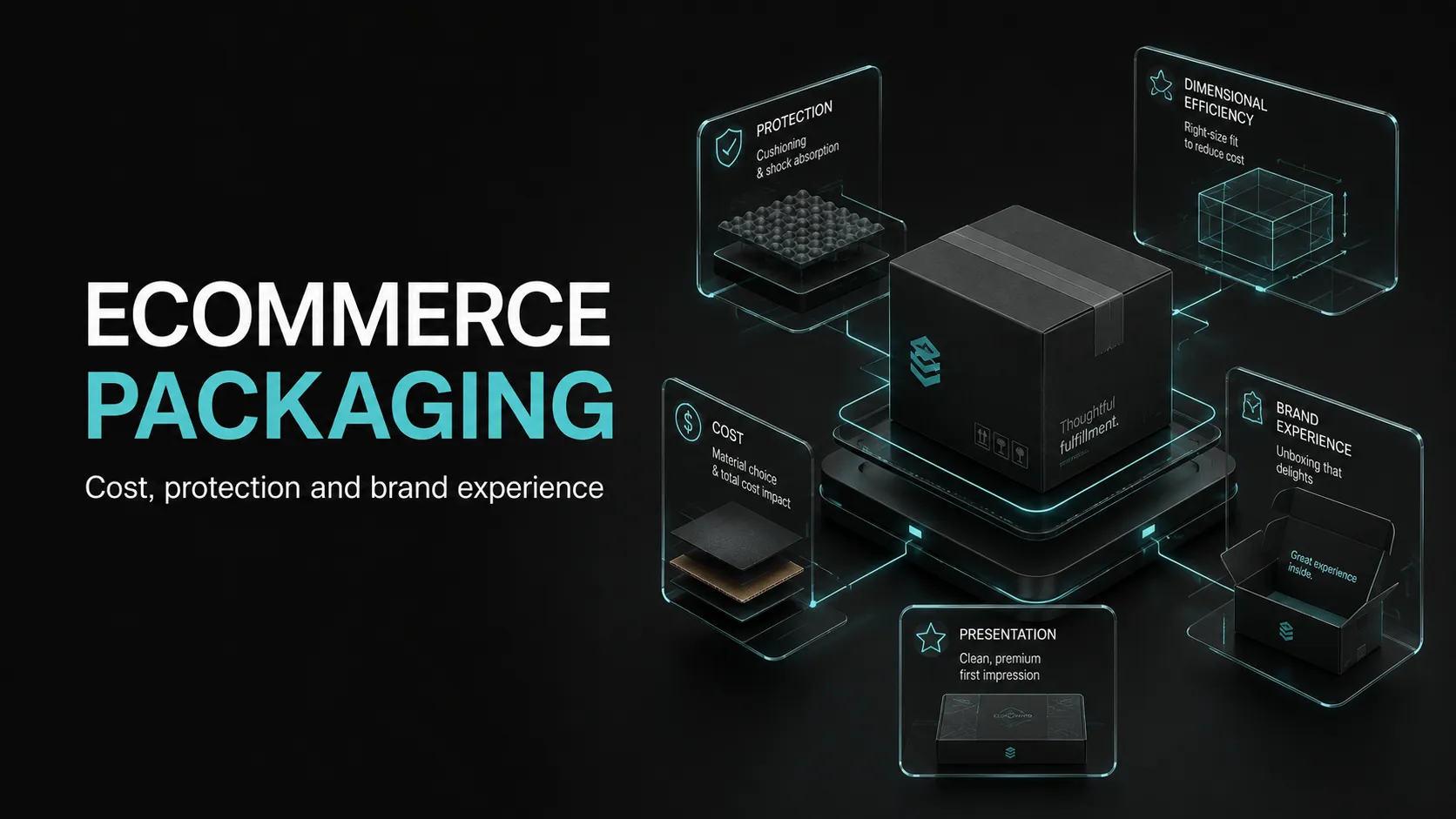
Good ecommerce packaging therefore has to balance three objectives at the same time: protect the product, control the total delivered cost, and present the brand appropriately. The best answer is usually a system of packaging rules rather than one premium box for every order.
Start with the product risk
Packaging design should begin with what is being shipped. Weight, shape, fragility, liquid content, value, temperature sensitivity and regulatory requirements all influence the protection needed.
A flexible apparel item and a glass skincare bottle should not share the same packaging logic simply because both fit in a similar box. Identify the most likely failure mode—crushing, movement, leakage, impact, moisture or tampering—and design around that risk.
Right-sizing affects both materials and transport cost
Carriers may calculate chargeable weight using parcel dimensions as well as actual weight. That means a lightweight product in an unnecessarily large carton can cost more to transport because it occupies more network capacity.
DHL’s guidance explains the same principle through dimensional or volumetric weight: shipping cost can be based on the greater of actual and dimensional weight. The exact formula varies by carrier and service, so use the rules in the relevant rate agreement rather than assuming one universal divisor.
Protection needs controlled empty space
Right-sizing does not mean forcing an item into the smallest possible container. Fragile goods may need clearance and cushioning. Under-filled boxes can collapse; tightly packed products can transfer impact directly to the contents.
The warehouse needs a repeatable packing rule for each product or order type: external container, inner protection, void fill, sealing and any orientation requirements.
Standardisation keeps the packing operation efficient
A brand may technically have dozens of possible packaging combinations. The warehouse has to store those materials, keep them replenished and teach packers when each one applies.
Reduce unnecessary options. A small set of well-selected box or mailer sizes can cover many orders if the rules are clear. Add specialist packaging only where the product risk or customer experience justifies it.
Branded packaging has an operational cost
Custom boxes, tissue, tape, cards and inserts can strengthen the unboxing experience, but every component becomes another piece of inventory. Someone has to receive it, store it, monitor its quantity and decide what happens when it runs out.
Define the fallback. If the branded mailer is unavailable during a campaign, can the warehouse use a neutral alternative, pause the order, or escalate for approval? That decision should not be improvised by a packer under dispatch pressure.
Packaging labour belongs in the cost model
Two packs with similar material cost can require very different labour. Folding a presentation box, wrapping a product, adding several inserts and applying multiple labels all increase handling time.
When comparing packaging alternatives, measure the completed pack process—not only the unit cost of cardboard. This becomes especially important when campaign volume rises.
Damage cost should be visible
A packaging saving can disappear after one replacement shipment. Track damage by SKU, packaging type and carrier where possible. Include replacement product, reshipment, customer-service work and write-off when reviewing the economics.
If damage clusters around one SKU or parcel format, test the pack rather than treating each claim as an isolated carrier problem.
Packaging and warehouse storage are connected
Branded boxes and protective materials consume warehouse space before they ever reach a customer. Large flat-packed cartons, inserts and multiple pack variants can materially increase the storage footprint of an ecommerce operation.
For outsourced warehousing or fulfilment, clarify whether packaging materials are tracked separately, how they are replenished and whether they occupy billable storage.
Sustainability should be evaluated with the complete pack
Reducing unnecessary material and parcel volume can support both cost and environmental goals, but a package that fails in transit creates another shipment and more waste. The strongest sustainability improvements usually remove material that does not contribute to protection or the intended experience.
Avoid broad environmental claims unless the material, certification and disposal route are verified. Operationally, the useful questions are simpler: how much material is used, can the pack be right-sized, and can complexity be reduced without increasing damage?
Test the finished parcel, not the design file
A packaging concept can look excellent on screen and fail at a packing bench. Build sample orders using the actual product, protective materials, labels and inserts. Check pack time, fit, sealing, barcode visibility and the state of the parcel after realistic handling.
For international shipments, follow the applicable carrier and dangerous-goods requirements where relevant rather than assuming a domestic pack is automatically suitable.
The best packaging system is deliberate
Shopify frames ecommerce packaging as both protection and a brand opportunity, while DHL emphasises package fit, protection and the effect of dimensions on transport. Together they point to the same operational conclusion: packaging should be designed around the total journey, not around the box alone.
When scoping ecommerce fulfilment with Stashworks, provide the product dimensions, fragility, standard and branded materials, inserts and fallback rules so the packing process can be priced and documented accurately.
For higher-risk products, continue with Fragile-Product Fulfilment. To understand how package size changes transport cost, see Dimensional Weight Explained.
Sources: Shopify, Ecommerce Packaging; DHL eCommerce, Chargeable Weight; DHL, Preparing Packages for International Shipping.