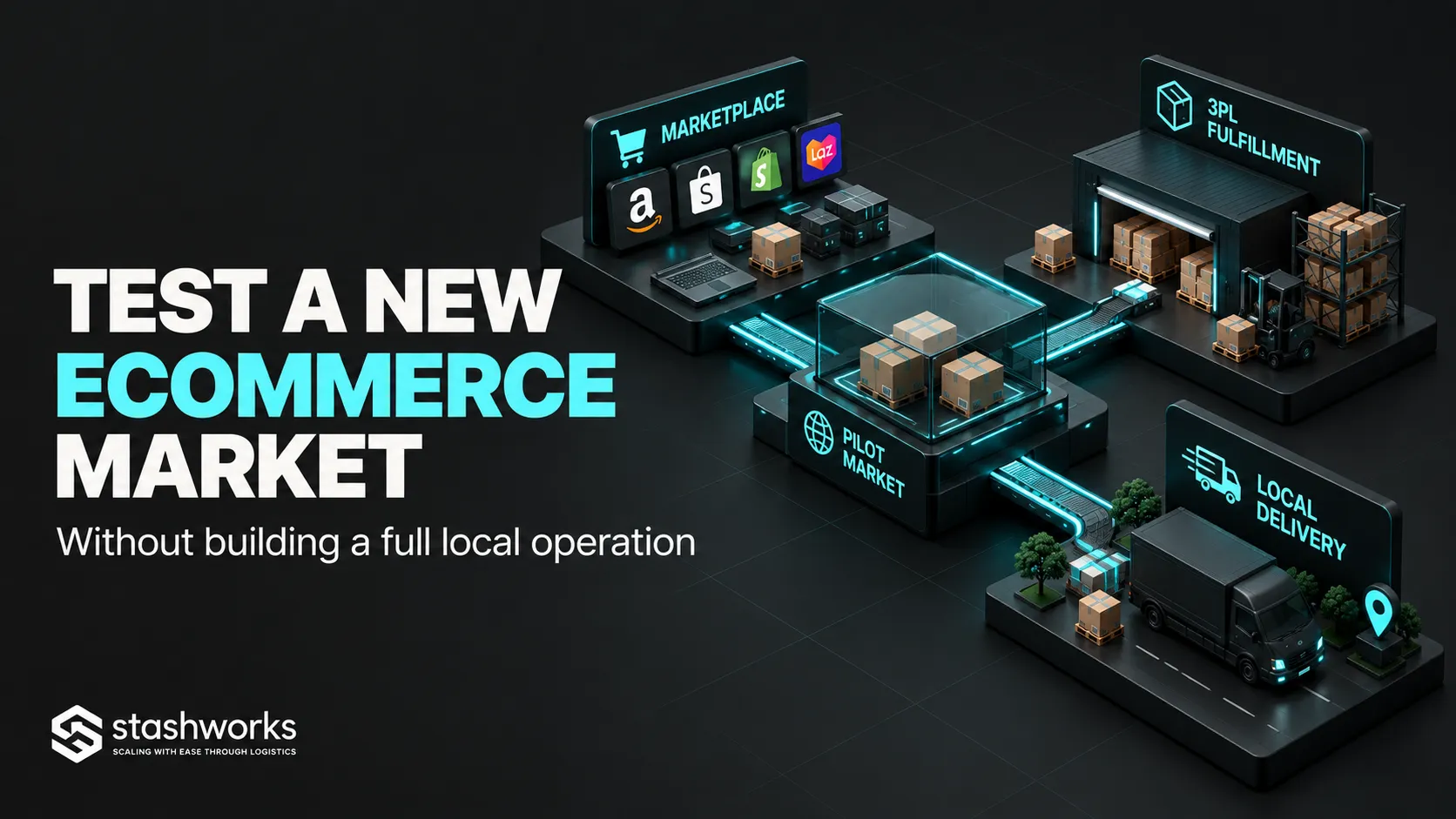
A new-market test should answer a commercial question before the business commits to a larger local structure. The aim is not to imitate a mature country operation at miniature scale. It is to learn whether the product, price, channel and customer proposition work under a controlled operating model.
That requires limiting the test without making it so artificial that the results are meaningless.
Write the hypothesis before choosing the setup
A useful test begins with a statement that can be disproved. For example: “Customers in this market will buy these three hero SKUs at this landed price through this marketplace with an acceptable acquisition cost and return rate.”
That is more useful than the vague objective “test Southeast Asia”.
Choose one market first
Launching in several countries simultaneously creates too many variables. Different regulations, channels, currencies, pricing and logistics make it difficult to understand why one result is stronger than another.
Use the country-validation framework in Southeast Asia Ecommerce Market Entry to choose a first test market based on demand and operational feasibility.
Reduce the catalogue
Start with products that are representative of the brand but operationally manageable. A small catalogue reduces product-compliance workload, inventory commitment, listing complexity and the number of failure modes.
Avoid choosing only the easiest SKU if it does not represent the commercial proposition you eventually want to scale.
Complete compliance work even for a test
A market test is still a commercial activity. Do not assume small volume creates an exemption from product registration, import permits, tax, marketplace rules or consumer obligations.
Validate the exact product and selling arrangement before launch. In Singapore, for example, commercial imports still require the applicable Customs process, and regulated categories such as food or cosmetics have specific requirements.
Use an existing local operating structure where appropriate
The brand may be able to test through a distributor, marketplace cross-border programme, local partner or a sell-on-behalf arrangement rather than immediately creating its own warehouse team and full local back office.
Stashworks positions SOBAAS partly for brands that want to test demand in a supported market before investing in a larger standalone operation.
Define the seller, account and inventory ownership
Even a short test needs a clear answer to who owns the marketplace account, who makes the sale to the customer, who owns the inventory, who receives payouts and who handles returns.
Do not accept a temporary setup that creates permanent ambiguity over ratings, listings, customer data or unsold stock.
Set a fixed inventory budget
Choose the maximum inventory value the business is willing to put at risk. Translate that into units by SKU after allowing for inbound freight, duties or taxes, receiving and safety stock.
The test should be large enough to reveal demand but small enough that an unsuccessful result does not create months of dead stock.
Use local stock only where it improves the test
Local inventory can produce a more realistic customer experience by shortening the fulfilment route and allowing local returns. It also increases upfront commitment.
Cross-border fulfilment may reduce local stock risk but can distort the test if delivery speed or landed price is materially worse than the eventual scaled model. A hybrid model can sometimes separate hero products from the long tail.
Limit channels so attribution remains clear
Choose one or two channels that fit the target audience. Launching simultaneously on every marketplace makes it harder to understand whether the product, platform or execution caused the result.
Add channels after the initial operating model is stable.
Localise enough to make the test fair
Use local currency, appropriate units, accurate shipping information, locally understandable copy and customer support that can answer the expected questions. A badly translated listing tests translation quality, not product demand.
The catalogue should still preserve approved product facts and regulatory wording.
Set a controlled acquisition budget
Define how much the business will spend to generate the test demand and which channels will receive the budget. Track acquisition cost, conversion and contribution margin rather than celebrating gross sales alone.
A test that requires unsustainably high promotion to generate orders may still be a negative result even if revenue appears respectable.
Measure operational quality as well as sales
Track order accuracy, dispatch, delivery exceptions, return reasons, support contacts and inventory discrepancies. A market can appear commercially attractive while producing an operating model that is too costly or fragile to scale.
Set a minimum test duration or order sample
A handful of launch-week orders can be misleading. Decide in advance what amount of time, traffic or completed orders will be enough to review the result.
Avoid extending the test indefinitely simply because the business does not want to declare it unsuccessful.
Use stop, continue and scale thresholds
Define three possible outcomes before launch. Stop if compliance, demand or economics fail. Continue testing if the signal is promising but inconclusive. Scale if demand and operations meet the predetermined thresholds.
This prevents the decision from being driven entirely by enthusiasm after the first successful campaign.
Plan the exit before stock arrives
If the test fails, decide how inventory can be sold down, transferred, returned, disposed of or moved to another market. Clarify marketplace access, customer obligations and partner termination at the beginning.
Unsold stock is part of the test cost and should be included in the downside scenario.
Scale only the parts that worked
A successful test does not require rebuilding the operation from scratch immediately. Increase inventory, products, channels or local infrastructure one layer at a time so the business can see which change affects performance.
The next step may be expanding the outsourced model rather than immediately opening a full local entity and warehouse.
General information only: Market testing does not remove legal, tax, import or product-compliance requirements. Confirm the proposed structure with the relevant authorities and advisers.
Sources: Stashworks, SOBAAS; ASEAN Trade Repository, Non-Tariff Measures; Singapore Customs, Import Permit.