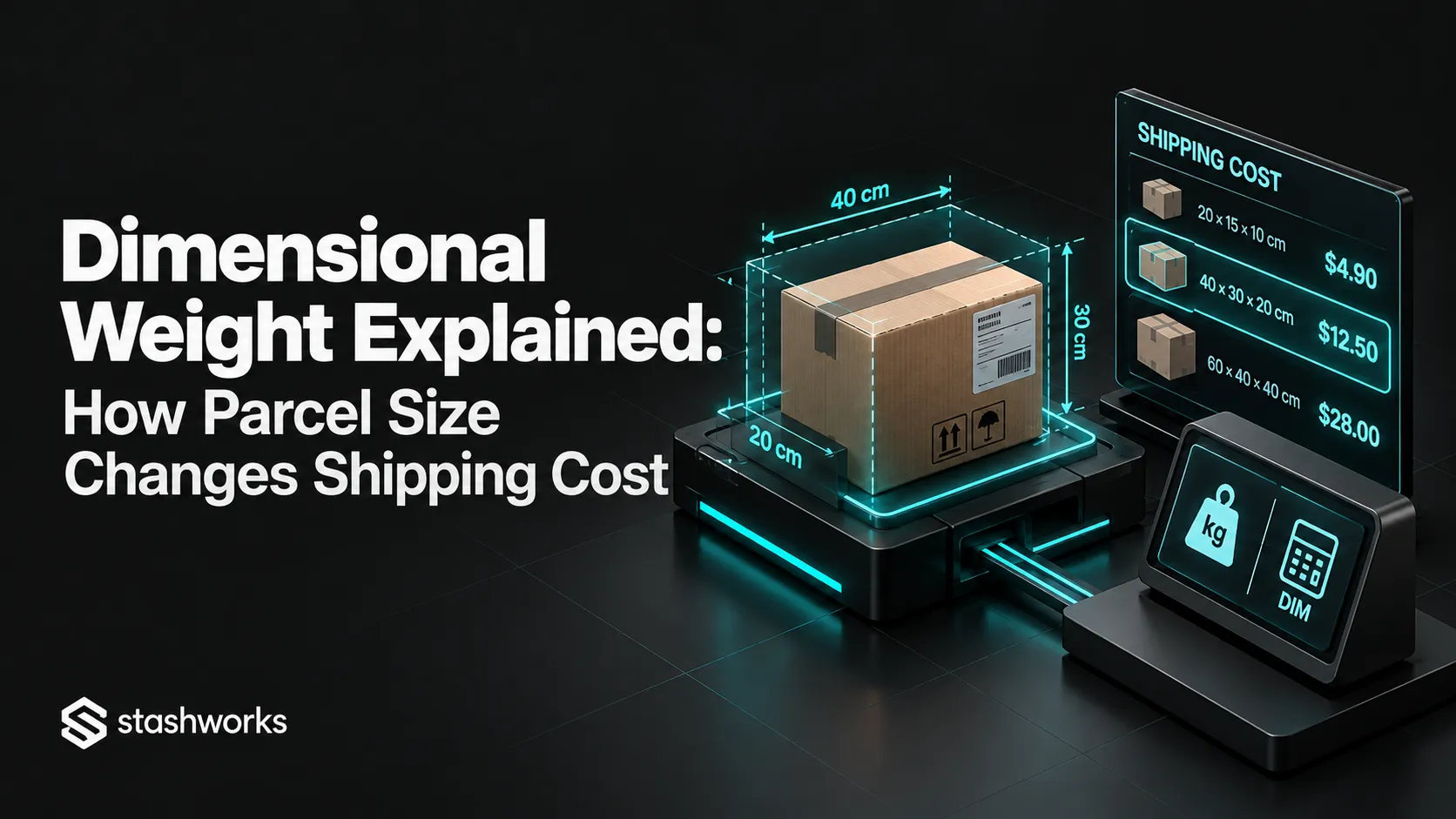
A parcel can weigh very little on a scale and still be expensive to ship because it occupies a large amount of transport space. Dimensional weight—also called volumetric weight—converts package size into a weight-equivalent so carriers can price bulky, low-density shipments more accurately.
For ecommerce brands, this makes packaging dimensions a shipping-cost variable rather than only a protection or branding decision.
Actual weight is what the parcel weighs
Actual weight is the scale weight of the packed shipment, including the product, inner packaging, outer box or mailer and any inserts.
Dimensional weight represents the space the parcel occupies
The common formula multiplies length, width and height and divides by a carrier-specific volumetric divisor. DHL Express, for example, publishes a standard express volumetric calculation using centimetres and kilograms.
Chargeable weight is usually the higher result
Carriers commonly compare actual and dimensional weight and charge using whichever is higher under the relevant service. A lightweight item in an oversized carton can therefore be billed as if it were much heavier.
The divisor is not universal
Do not hard-code one dimensional-weight factor into every shipping model. The divisor can vary by carrier, service, region and transport mode.
Measure the finished parcel, not the product
Shipping dimensions are based on the packed shipment. Product dimensions alone miss the box, cushioning and empty space added during fulfilment.
Right-sizing can reduce chargeable weight
If protection remains adequate, reducing unnecessary empty space can lower dimensional weight and material use at the same time.
The existing Ecommerce Packaging guide covers the broader balance between protection, cost and customer experience.
Do not shrink packaging until damage risk rises
A smaller box can reduce freight cost but create more product movement, compression or breakage. The target is the smallest package that still protects the product through the real distribution environment.
Fragile products can justify extra volume
Fragile goods may need cushioning, dividers or double boxing. That protective volume can increase dimensional weight, so the shipping-cost model should include it before the product is priced or promoted.
The controls are covered in Fragile-Product Fulfilment.
Multiple-item orders change the calculation
Consolidating items into one parcel can reduce the number of shipment charges, but a much larger box may create higher dimensional weight. Test common basket combinations rather than assuming one large carton is always cheaper.
Oversize thresholds can create additional charges
Beyond dimensional weight, carriers can impose additional handling, oversize or non-standard package charges when parcels exceed specified dimensions or shapes.
Use cartonisation rules
A warehouse can map products to a small set of approved box sizes and choose the smallest suitable carton for the order. This reduces random overpacking and makes dimensional cost more predictable.
Store accurate product dimensions
Warehouse cartonisation and shipping estimates depend on correct dimensions. Update the product master when packaging changes.
Audit carrier invoices against captured dimensions
Carriers can remeasure shipments. Compare billed weight with warehouse-recorded dimensions and actual weight when investigating unexpected charges.
Model dimensional weight at SKU and basket level
For bulky products, estimate chargeable weight for a single-item order and common multi-item baskets. Include destination and service because transport economics differ by lane.
Use dimensional cost in product decisions
A low-margin product that ships mostly as dimensional weight may need redesigned packaging, bundle strategy, local inventory or a different delivery service.
Where Stashworks fits
Stashworks' Ecommerce Fulfilment service includes packing and shipment preparation within the agreed scope. Brands should provide accurate product dimensions and packaging requirements so parcel selection and delivery quotations reflect the actual packed profile.
Sources: DHL, About Weight and Volumetric Weight; DHL Global Forwarding, Calculating Chargeable Weight; UPS, How to Ship a Package.