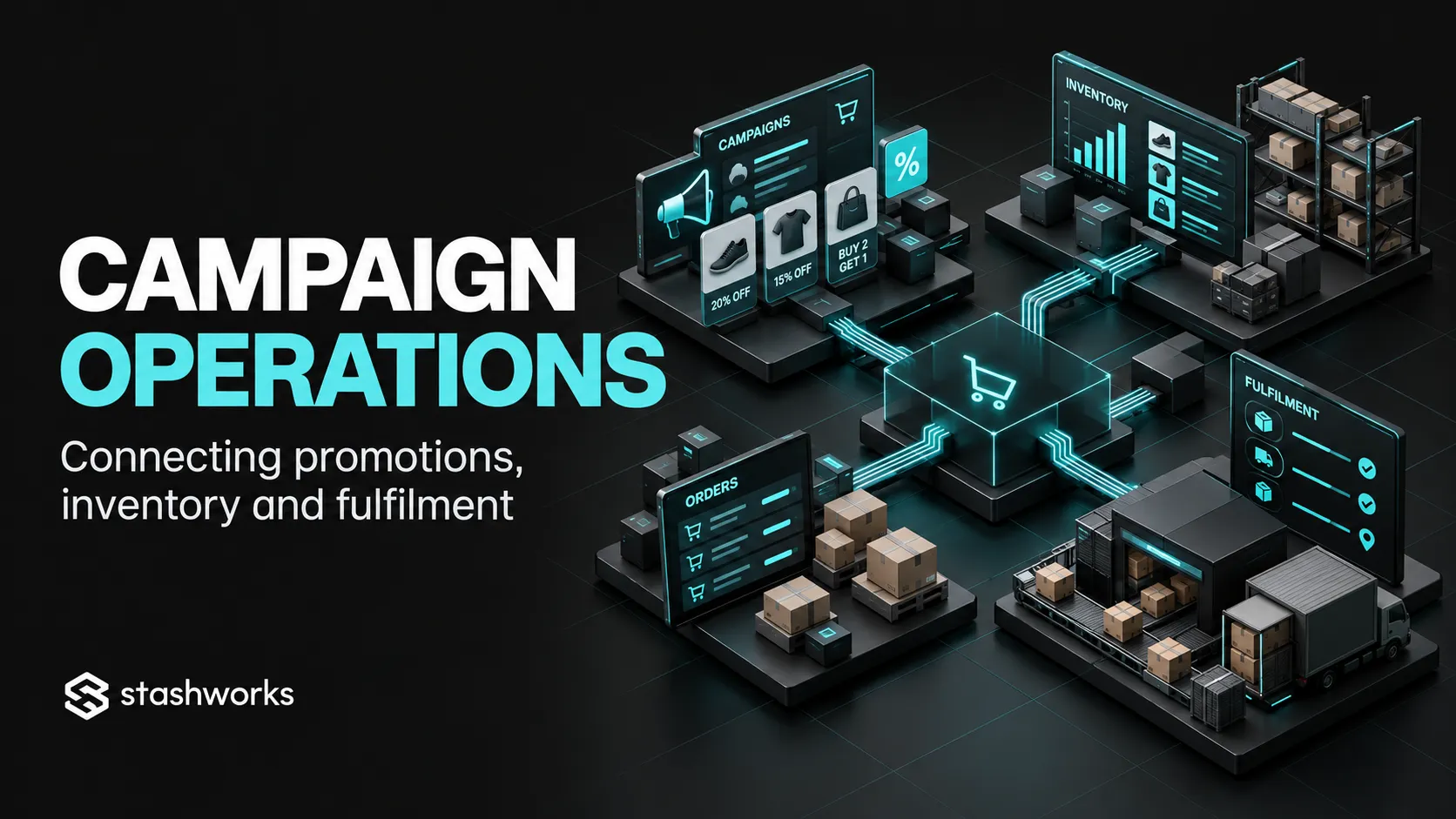
A marketplace campaign is not complete when the discount is configured. The operational work starts earlier: the participating products must be correct, stock must be available, the warehouse must be ready for the demand pattern, dispatch rules must be understood and customer-service teams need to know what has been promised.
For growing brands, campaign operations is the discipline that connects promotional activity to inventory and fulfilment before the campaign creates exceptions.
Start with a campaign brief that operations can use
A marketing calendar is not enough. The operational brief should identify the marketplace, campaign dates, participating SKUs, approved price or mechanic, expected demand range, inventory source, replenishment plan, fulfilment location, delivery promise and any special customer messaging.
Stashworks' current Ecommerce Enablement service includes campaign support around promotion setup, campaign coordination and fulfilment readiness. The exact activities still need to be agreed for the account.
Lock the participating SKU list before stock is committed
Campaigns often create problems when product selection changes repeatedly while inventory and fulfilment teams are planning against an older list. Use one approved campaign-SKU file or system record with a version owner.
Each marketplace product should map clearly to the internal SKU or variant that the warehouse will fulfil. If a promoted listing is mapped incorrectly, stronger demand only amplifies the error.
Confirm the inventory position, not just the headline stock number
The relevant question is how much stock is genuinely available for the campaign after existing orders, reservations, safety buffers and other channels are considered. A marketplace dashboard showing stock does not automatically mean every displayed unit is safe to commit.
The multichannel controls in How to Manage Inventory Across Shopify, Shopee, Lazada and TikTok Shop are especially important during promotions because several channels can compete for the same physical inventory.
Decide whether stock needs a campaign allocation
For high-risk campaigns, the brand may choose to reserve or protect a quantity for the participating channel. That decision should be based on demand, replenishment timing and the consequences of stockouts elsewhere.
There is no universal rule that campaign stock must be ring-fenced. The useful control is to make the allocation decision explicit rather than letting channels consume inventory unpredictably.
Forecast the shape of demand, not only the total
Two campaigns with the same total order volume can create very different warehouse pressure. One may spread demand across several days; another may create a sharp order spike after a livestream, voucher release or campaign launch.
Translate the commercial forecast into orders per hour or day, order lines, units, likely top SKUs and packaging demand. That gives the fulfilment team something operational to plan against.
Check warehouse capacity before the campaign is submitted
Campaign readiness should include stock receiving, storage locations, pick capacity, packing stations, packaging material, carrier handover and exception handling. If replenishment stock is still inbound, include the receiving window in the plan rather than assuming it will be immediately saleable.
The existing 9.9, 11.11 and 12.12 Fulfilment Planning Checklist provides a deeper peak-readiness framework for major sale periods.
Align marketplace deadlines with internal cut-offs
Every marketplace campaign still operates within order-processing and dispatch rules. The commercial team should know the latest safe time for orders to enter warehouse processing and what happens when an order is cancelled, held or changed.
Use the workflow in Marketplace Dispatch SLAs to translate marketplace deadlines into operational priorities rather than reacting after orders become late.
Prepare content and pricing controls before launch
Campaign errors can be commercial as well as operational. Confirm the correct listing, variant, approved price, promotion mechanic and campaign creative before submission. Where several people can edit the same seller account, define who has final approval authority.
Lazada University currently includes campaign management, effective promotions and pricing among its seller education topics, reinforcing the need to manage campaigns as a controlled operating process rather than a one-click discount.
Give customer service the campaign context
Campaigns can generate questions about stock, vouchers, delivery, order status and returns. Customer-service teams should have the campaign dates, participating products, approved customer wording and escalation routes before traffic increases.
This reduces the chance that support staff promise an outcome that the marketplace, warehouse or carrier cannot deliver.
Monitor exceptions while the campaign is live
A live operations view should focus on exceptions rather than only sales. Useful checks include stock risk, unmapped orders, failed integrations, late order queues, packing backlog, carrier handover risk and unusual customer-service volume.
Escalation ownership should be defined in advance so a problem can move quickly to the team that can actually resolve it.
Reconcile after the campaign
Once the campaign ends, compare the planned demand with actual orders, cancellations, fulfilled units, stockouts, late dispatch, returns and customer-service issues. Reconcile inventory before the next promotion uses the same products.
A post-campaign review should identify which assumptions were wrong and which operational controls worked. That is more valuable than simply recording that the campaign exceeded or missed its sales target.
Where Stashworks fits
Stashworks positions Campaign & Promotion Support as part of Ecommerce Enablement and connects that activity to its fulfilment and technology layers. That connection is useful when campaign planning needs to account for physical stock and warehouse execution.
The practical next step is to turn every campaign into one shared operating brief covering product, price, stock, forecast, fulfilment, dispatch and customer-service ownership.
Sources: Stashworks, Ecommerce Enablement; Lazada University Singapore.