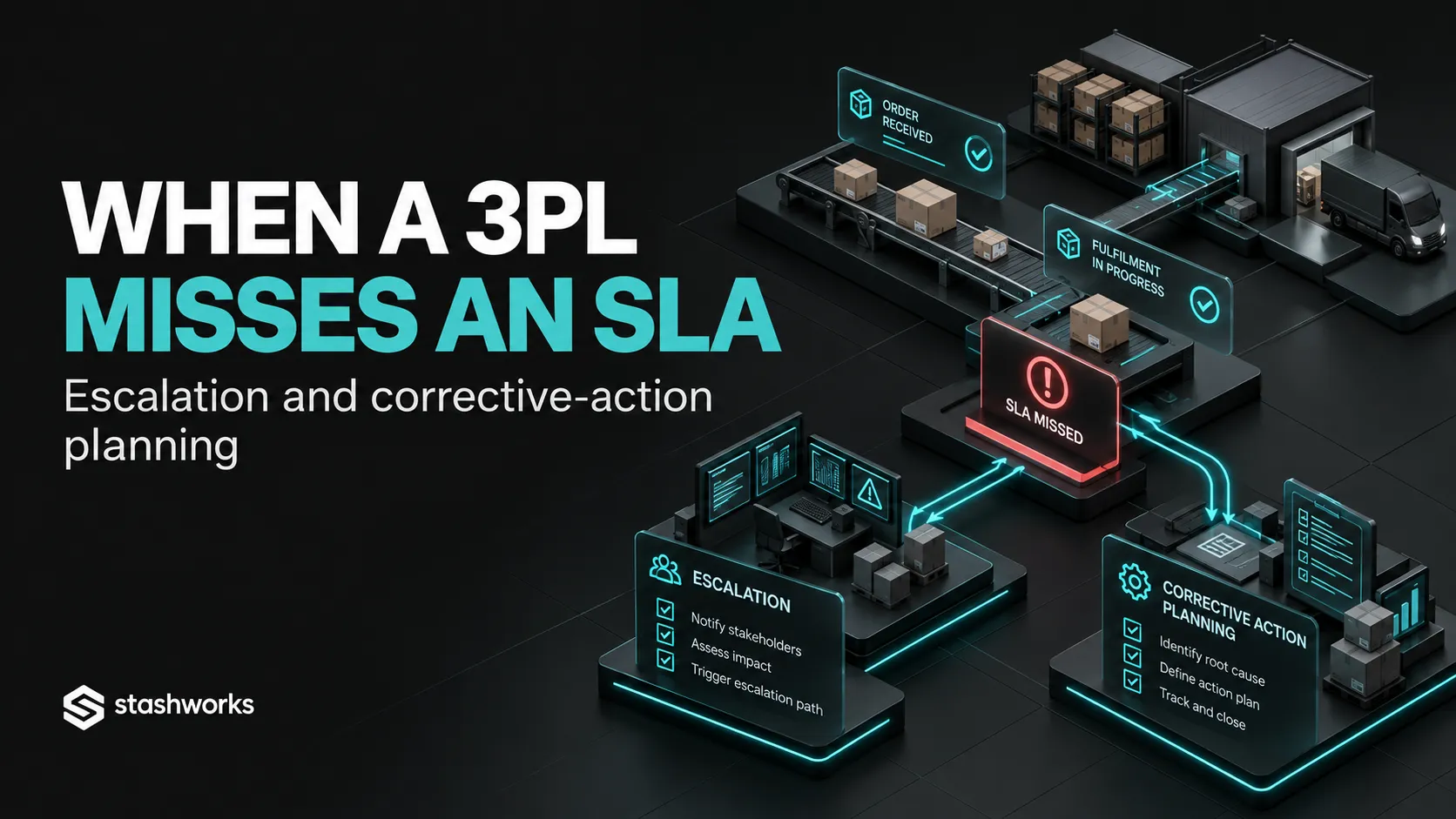
An SLA miss should trigger a controlled response, not an immediate blame exercise. The first priority is to protect customers and inventory; the second is to understand why the failure happened; the third is to prevent recurrence.
A clear escalation and corrective-action process helps both brand and 3PL move from incident to improvement.
Confirm that the SLA actually applies
Check the metric definition, qualifying orders, measurement period, exclusions and data source. Many disputes begin because the parties are measuring different populations.
Do not spend hours on root cause before confirming that the event is genuinely inside the agreed SLA.
Contain the operational impact
If the issue is still active, stop further harm. That may mean prioritising delayed orders, quarantining inventory, pausing a broken integration, changing carrier routing or temporarily restricting a workflow.
Containment is not the permanent fix; it is the action that stabilises the operation.
Build one incident record
Record when the issue began, affected orders or SKUs, systems involved, customer impact, people notified and actions taken. Preserve system logs, scans, shipment records and communication where relevant.
A shared timeline reduces disagreement later.
Separate symptom from root cause
“Orders were late” is the symptom. The root cause may be incorrect inventory, labour shortage, WMS failure, late inbound stock, catalogue mismatch, carrier collection failure or an unplanned campaign spike.
Use evidence to trace the process backwards rather than accepting the first plausible explanation.
Use a structured root-cause method
Five Whys, cause-and-effect analysis or another simple method can help. The tool matters less than proving the relationship between cause and outcome.
Avoid root causes such as “human error” unless the analysis explains why the process allowed that error to reach the customer.
Define corrective and preventive actions separately
A corrective action fixes the identified problem. A preventive action reduces the chance of similar problems recurring elsewhere.
For example, correcting one SKU mapping solves the immediate issue; adding a duplicate-mapping validation step may prevent the class of error.
Assign an owner and due date
Every action needs one accountable owner. Shared ownership often means no ownership.
Set due dates according to risk and operational complexity, then record dependencies that may delay the fix.
Verify the fix with evidence
Do not close the action because a process document was updated. Test the new workflow, review a sample of affected transactions or monitor the metric over an agreed period.
The verification method should be defined when the action is created.
Escalate based on severity and recurrence
A one-off minor miss may stay with account operations. Repeated or high-impact failures may require senior operational, technology or commercial escalation.
Define the escalation ladder before a serious event occurs.
Communicate with customers only from verified facts
If the SLA miss affects customer orders, customer-service teams need accurate status and approved messaging. Avoid promising recovery before the warehouse or carrier can support the statement.
Track service credits separately from operational recovery
Where the contract includes service credits or other remedies, process them according to the agreement. Do not treat a financial credit as the corrective action; customers still need the operation fixed.
Use recurrence as a governance signal
Repeated misses in the same process may indicate insufficient capacity, weak controls, inaccurate assumptions or a service design that no longer fits the business.
At that point, the response may require redesign rather than another isolated action.
Update the risk register
A significant incident is new evidence about operational risk. Update likelihood, impact, controls and continuity plans where necessary.
The framework in 3PL Risk Management can be used for that review.
Review the incident at the monthly meeting
Carry open actions into the 3PL Performance Review so accountability survives beyond the incident call.
Know when a miss becomes a contract issue
Repeated material failures, disputed liability or termination rights can require legal review. Operational teams should document facts and avoid interpreting contract remedies beyond their authority.
Stashworks does not publish universal SLA remedies on its current website, so any escalation rights must come from the actual agreement.
General information only: Contractual remedies depend on the specific agreement and applicable law. This article is not legal advice.
Sources: Stashworks, 3PL Singapore; Ministry of Manpower, Business Continuity Planning.