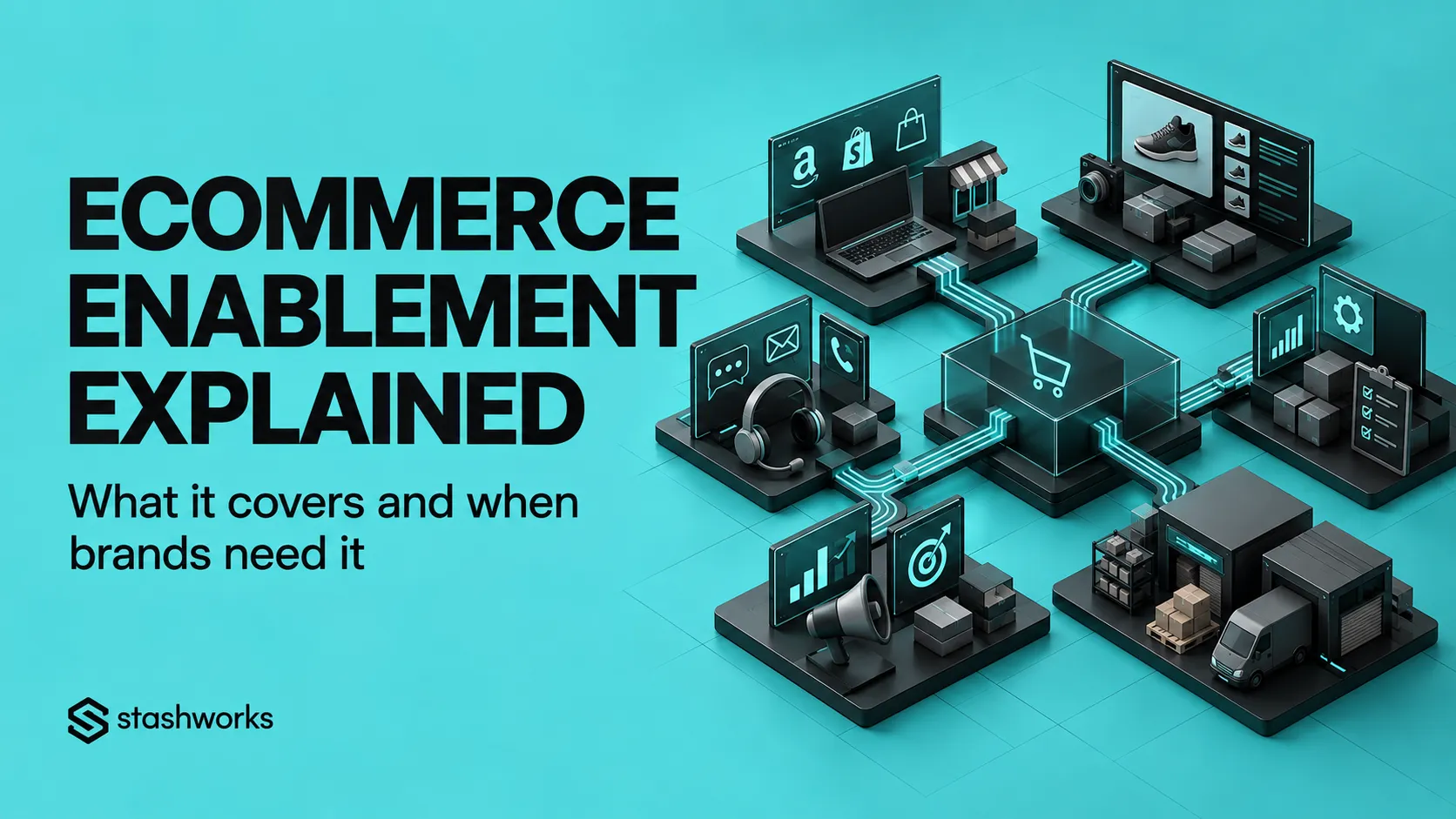
Ecommerce enablement is the operational work that keeps online sales channels functioning around the order itself. It sits between commercial activity and physical fulfilment: products need to be listed correctly, campaigns need to be coordinated with stock, customer enquiries need owners, and marketplace activity needs to stay connected to the systems that actually fulfil the order.
For a growing brand, the question is not whether these tasks exist. It is whether the internal team still has the capacity, controls and platform expertise to manage them consistently across every channel.
What ecommerce enablement covers
The scope can vary by provider, so the term should never be treated as a fixed package. On Stashworks' current Ecommerce Enablement page, the service is organised around marketplace and platform management, listings and content operations, campaign support, customer support, and coordination with fulfilment and logistics.
That makes ecommerce enablement different from a marketing-agency brief. It is closer to day-to-day channel operations: keeping products, promotions, orders and service workflows organised enough that the commercial plan can actually be executed.
The operating layer between commerce and fulfilment
A storefront can look healthy while the underlying operation is fragmented. A campaign may go live without enough stock. A product title may be correct on one marketplace but the variant mapping may not match the warehouse SKU. A customer-service team may answer an order-status question without seeing the latest fulfilment state.
Ecommerce enablement is designed to reduce those gaps. It connects the digital work around selling with the physical and system workflows behind storage, order processing, dispatch and returns.
When a brand usually starts needing it
The trigger is rarely a specific order volume. It is usually a loss of operational control as channels, products and campaigns multiply.
Common signals include repeated listing updates taking too long, different teams maintaining separate product spreadsheets, marketplace campaigns being planned without warehouse input, customer enquiries bouncing between departments, or founders and commercial staff spending increasing amounts of time on routine seller-centre administration.
Multichannel sellers often feel the pressure first because each additional channel introduces another set of product records, workflows and exceptions. The inventory side of that problem is covered in How to Manage Inventory Across Shopify, Shopee, Lazada and TikTok Shop.
Enablement does not replace fulfilment
Ecommerce enablement manages the operational work around online stores and marketplaces. Ecommerce fulfilment manages the physical order workflow: receiving and storing stock, picking, packing, dispatch and returns.
The two can be connected, but they solve different problems. A brand can have excellent marketplace administration and still fail operationally if warehouse capacity is weak. It can also have an accurate warehouse but lose sales because product data, campaigns and channel operations are poorly maintained.
Enablement is also different from market entry
Stashworks positions SOBAAS as a separate Sell On Behalf market-entry model for supported markets. Ecommerce Enablement, by contrast, supports operational work around existing ecommerce stores and marketplaces.
That distinction matters because market entry can involve commercial, compliance and local operating questions that go beyond marketplace administration. Brands should not assume that outsourcing listings or campaign support automatically solves entity, tax, regulatory or selling-arrangement requirements.
Build the service around a responsibility split
The most useful enablement setup starts by deciding who owns each activity. Stashworks' current onboarding structure explicitly includes a responsibility split before launch.
A practical responsibility matrix can separate catalogue ownership, content approval, price approval, promotion setup, inventory decisions, customer-response ownership, fulfilment exceptions and platform access. The purpose is to prevent two parties from both assuming the other is responsible for the same task.
Prepare product and catalogue data before handing over operations
Outsourcing a messy catalogue does not make it clean. The brand should first establish stable product identifiers, variant structure, barcodes where applicable, approved content and the relationship between marketplace products and warehouse SKUs.
The existing guide on SKU Management explains why product identity needs to remain consistent between commercial channels and warehouse records.
Access should be deliberate, not shared casually
An external operations partner may need access to marketplaces, ecommerce platforms or advertising tools, but the safest model is role-based access with only the permissions required for the agreed work. Platform-specific controls differ, so brands should use the access model supported by each platform and remove access when the engagement ends.
Shopify currently provides role-based permissions and collaborator access controls, while TikTok Business Center supports permissions at member, account and asset level. Those controls are preferable to giving an external operator a shared owner login.
Measure whether the operating model is actually improving
The right measures depend on scope. A listings-heavy engagement might track catalogue backlog, error rate and time to resolve rejected listings. A campaign-heavy engagement might track campaign-readiness exceptions, promoted-SKU availability and dispatch performance. A customer-operations scope might track open enquiry backlog and escalation ageing.
Avoid one vanity metric for the whole service. The measures should correspond to the responsibilities that were actually outsourced.
How Stashworks positions Ecommerce Enablement
Stashworks currently describes its Ecommerce Enablement service as support for agreed ecommerce stores and marketplaces across platform management, listings, campaigns, customer enquiries and coordination with fulfilment. Its technology and fulfilment services provide the operational connection between sales channels, inventory and warehouse activity.
For a brand considering the service, the next step is to define the channels, catalogue size, campaign workload, customer-support scope and fulfilment setup that need to be included. That produces a clearer brief than simply asking for “marketplace management”.
For brands using ecommerce operations as part of a new-country launch, Sell On Behalf as a Service explains how marketplace work, local inventory and fulfilment can sit inside a broader Southeast Asia market-entry model.
Sources: Stashworks, Ecommerce Enablement; Shopify Help Center, Roles; TikTok Business Center, Account and asset permissions.