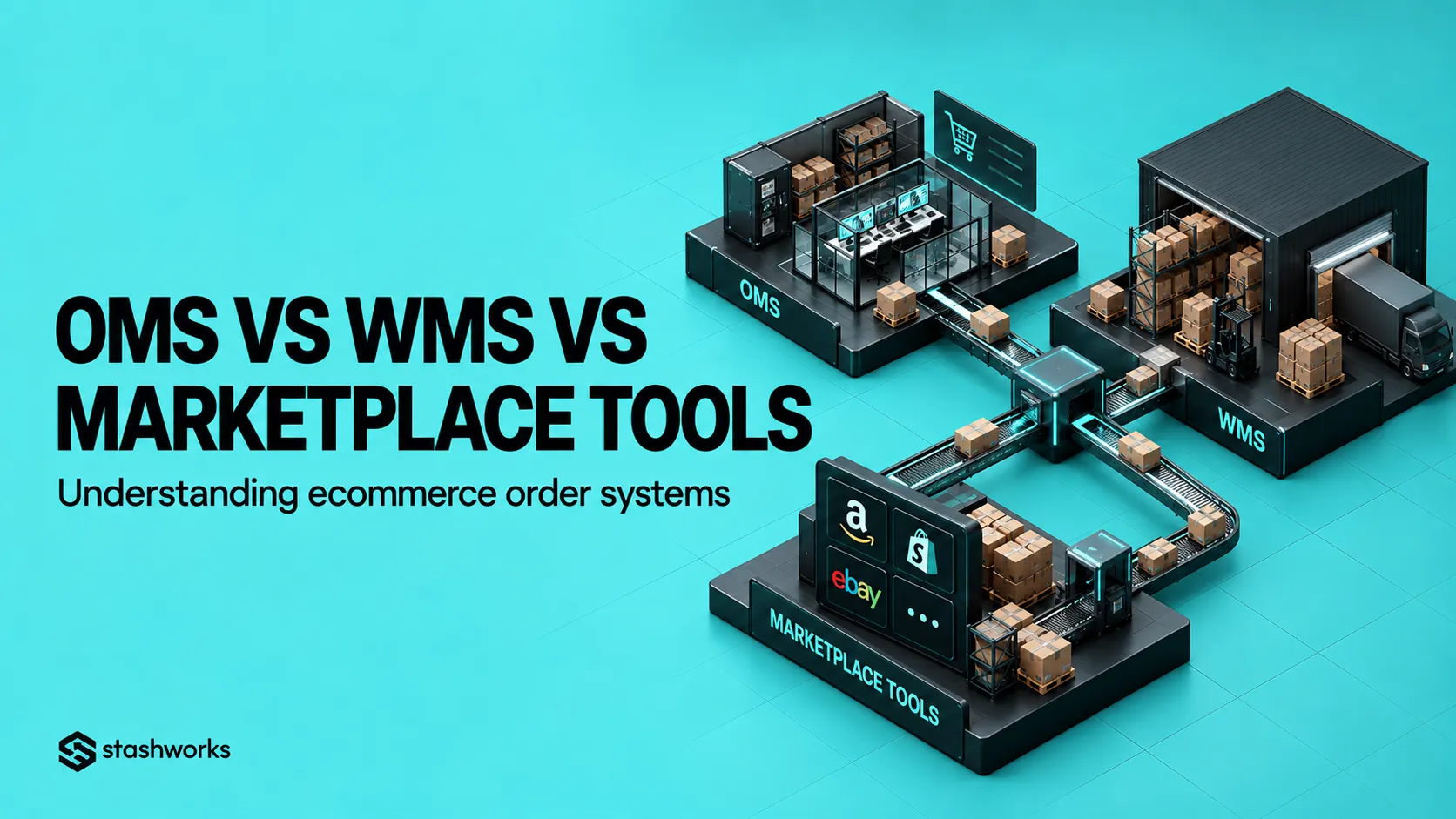
Ecommerce operations often use several systems that all appear to “manage orders”. A marketplace has an order screen, an OMS routes demand, and a WMS executes warehouse work. Problems begin when two systems both assume they are the source of truth for the same decision.
The clearest architecture gives each layer a specific job.
A marketplace tool manages the commercial channel
Seller centres and ecommerce platforms capture the customer order, product listing, payment context, channel status and customer-facing information.
They can also expose inventory and fulfilment controls, but their primary perspective is the sales channel rather than the physical warehouse.
An OMS coordinates what should happen to the order
An order management system can consolidate orders from several channels, apply routing or orchestration rules, split demand, manage holds and decide which fulfilment node should receive the work.
Microsoft describes Intelligent Order Management as an orchestration layer for order flows across platforms, apps and fulfilment partners.
A WMS controls what physically happens inside the warehouse
A warehouse management system manages receiving, locations, inventory states, picking, packing, shipment release, counts and other physical warehouse work.
Its strength is execution against actual stock and warehouse locations.
The systems can overlap without being interchangeable
A modern ecommerce platform may provide routing and inventory features. A WMS may display orders. An OMS may expose stock. Overlap is normal.
The architecture still needs one authoritative system for each critical decision.
Define who owns the order record
Decide which system holds the commercial order and which holds the fulfilment work order. Preserve shared identifiers so the same transaction can be traced across systems.
Define who owns product master data
Product titles and merchandising may originate in ecommerce, while physical dimensions, barcode and handling rules may be maintained in warehouse or ERP systems.
Use controlled synchronisation rather than allowing every system to edit every field.
Define who owns available-to-promise inventory
The WMS knows physical inventory states; an OMS or commerce platform may calculate what can be promised across locations and channels.
Make the transformation explicit: on-hand stock is not automatically equal to sellable channel availability.
Define who routes the order
If there are multiple fulfilment locations, the routing decision may sit in the ecommerce platform, OMS or another orchestration layer. Only one system should make the final assignment unless there is a deliberate hierarchy.
Shopify's current order-routing tools illustrate how a commerce platform can apply rules such as minimising split fulfilments, staying within a destination market and shipping from a preferred or nearby location.
Define who creates the warehouse task
Once the fulfilment location is chosen, the WMS should receive enough information to create the physical picking and packing workflow without reinterpreting the commercial order.
Define who handles cancellations
A cancellation begins in the commercial channel, but whether it can still stop fulfilment depends on warehouse status. The systems need a clear acknowledgement path.
Define who returns tracking
The WMS or shipping tool can generate shipment data, but the commerce platform must receive the correct tracking number and fulfilment status for the customer's order.
Define who manages returns
Return authorisation may originate in the marketplace or ecommerce platform, while physical inspection and inventory disposition happen in the warehouse.
Refund authority can sit elsewhere again. One “returns system” is not always responsible for every step.
Use an OMS when orchestration complexity justifies it
A single-channel, single-warehouse brand may not need a separate OMS. Complexity increases when the business has many channels, locations, fulfilment partners, allocation rules or order-routing decisions.
Do not add an OMS simply because the acronym appears on an enterprise architecture diagram.
Use the WMS to control physical truth
The WMS should know where stock is, which state it is in and what warehouse work has happened. Commercial systems should not overwrite that physical truth casually.
Marketplace tools remain essential even with an OMS
Channel-specific campaign, listing, customer-service and policy tasks still live within the marketplace environment. An OMS does not replace marketplace operations.
The operating layer is explained in Marketplace Management in Singapore.
Integrations should be designed as events
Map new order, change, cancellation, inventory update, fulfilment, tracking and return events between systems. Decide which direction each event travels and what happens when it fails.
Use the Platform-to-Warehouse Integration Checklist to test those flows.
Use one architecture table
A simple ownership map prevents duplicate responsibility.
Where Stashworks fits
Stashworks' Technology page describes inventory management, order management and warehouse management within its connected fulfilment operation. That does not mean every client requires a separate standalone OMS. The exact system boundary depends on the brand's existing stack, channels and orchestration needs.
Sources: Microsoft Learn, Intelligent Order Management Overview; Shopify Help Center, Understanding Order Routing; Stashworks, Technology.