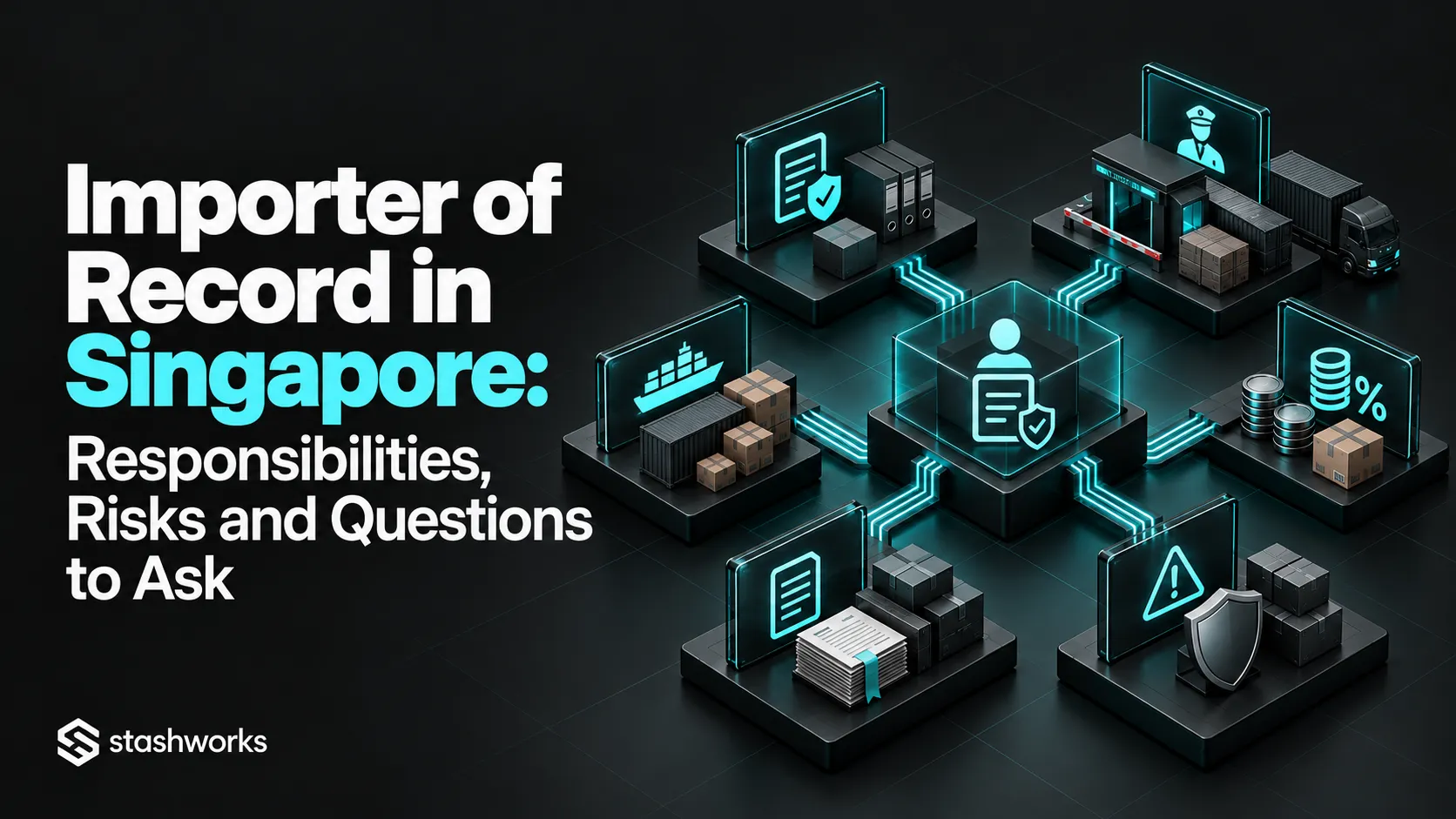
The phrase “Importer of Record” is widely used in logistics, but Singapore Customs defines the operative role more directly: the importer is the party who brings goods into Singapore and is responsible for the import declaration and associated obligations.
Before inventory moves, ecommerce brands should know exactly which entity is acting as importer, which declaring agent is submitting permits and which party holds product-specific licences or approvals.
Start with Singapore Customs' definition of importer
Singapore Customs states that the importer is the party bringing the goods into Singapore. For postal or courier shipments, the importer may be the consignee named on the relevant freight document, subject to the shipment structure.
The commercial label “Importer of Record” should therefore be mapped back to the actual customs declaration and consignee arrangement.
The importer needs the appropriate UEN and Customs account
To submit import permit applications, the importing entity needs a Unique Entity Number and an activated Customs account.
A business can appoint a Declaring Agent to submit permits on its behalf, but appointing an agent does not make the underlying importer role disappear.
The declaring agent and importer are different roles
A freight forwarder or customs specialist may act as the Declaring Agent. That party prepares and submits declarations through TradeNet according to the authorised arrangement.
Confirm whether the provider is only submitting the permit or also taking another commercial role in the transaction.
The importer must support accurate classification
The import declaration requires the correct Harmonised System classification and, where relevant, product-control information.
Do not assume the forwarder can determine a complex product classification from a marketing description alone.
The importer must support accurate customs value
Commercial invoice, freight, insurance and other relevant adjustments determine the customs value. Incorrect value can lead to underpaid or overpaid GST or duty.
Use Customs Valuation in Singapore for the documentation framework.
Controlled goods may require additional licences or approvals
Singapore imports are regulated not only by Customs. Product categories can involve authorities such as HSA, SFA or the Consumer Product Safety Office.
The importer arrangement should identify which party holds any required licence, notification or registration.
Product compliance and customs clearance are separate checks
A Customs permit does not by itself prove that every product-sale requirement has been satisfied. The brand needs to confirm both border entry and legal supply requirements.
The research process in Product Compliance Before Market Entry can be used for the product layer.
Incoterms® do not automatically create a workable importer
A supplier can quote DDP, but the seller still needs a practical and compliant way to complete import clearance and tax obligations in Singapore.
The Incoterm allocates contractual responsibilities; it does not override Singapore Customs registration or product rules.
Do not assume the warehouse is the importer
Inventory can be delivered to a 3PL warehouse without the warehouse operator acting as importer. The warehouse address and importer identity are separate concepts.
Confirm import responsibility before using a 3PL address on commercial documents.
Do not assume the freight forwarder is the importer
A forwarder can arrange transport and may act as Declaring Agent, but that does not necessarily mean it accepts importer responsibility.
Ask the role explicitly rather than inferring it from who booked the shipment.
Understand who pays GST and duty
The import declaration needs an account or payment arrangement for applicable GST and duty. The commercial contract should state which party ultimately bears these costs and how they are recharged where relevant.
Keep records that support the declaration
Maintain commercial invoices, packing lists, transport documents, permits, valuation evidence, product licences and correspondence used to make the declaration.
The importer should be able to explain the transaction later if queried.
Ask whether the provider is acting as principal or agent
If a market-entry or logistics provider offers an importer-related service, clarify whether it imports in its own name, acts only as an agent, or coordinates a third-party importer.
That distinction can affect risk, tax, product registration and contractual responsibility.
Ask what products the arrangement excludes
An importer model that works for apparel may not work for food, cosmetics, batteries or regulated electronics. Confirm the actual catalogue, not only the business category.
Ask what happens to rejected or returned imports
Define responsibility for customs holds, missing licences, wrong declarations, rejected shipments and re-export. The importer should not first learn about these costs during an exception.
Ask how valuation and classification decisions are approved
Where the brand supplies product data and the declaring agent submits the permit, decide who signs off unusual HS classification or customs-value questions.
Ask how the role ends
If the brand changes provider or establishes its own local entity, determine how Customs authorisations, permits, product registrations and inventory records transition.
Where Stashworks fits
Stashworks offers Freight Forwarding, warehousing and SOBAAS market-entry services, but its public website does not state a universal importer-of-record arrangement for every product or market. The importer, declaring agent and compliance responsibilities therefore need to be confirmed for the specific engagement.
General information only: Importer, customs, tax and product-compliance responsibilities can create legal and regulatory consequences. This article is not legal or tax advice.
Sources: Singapore Customs, Import Procedures Overview; Singapore Customs, Obtain a Customs Import Permit; Singapore Customs, Customs Registration Overview.