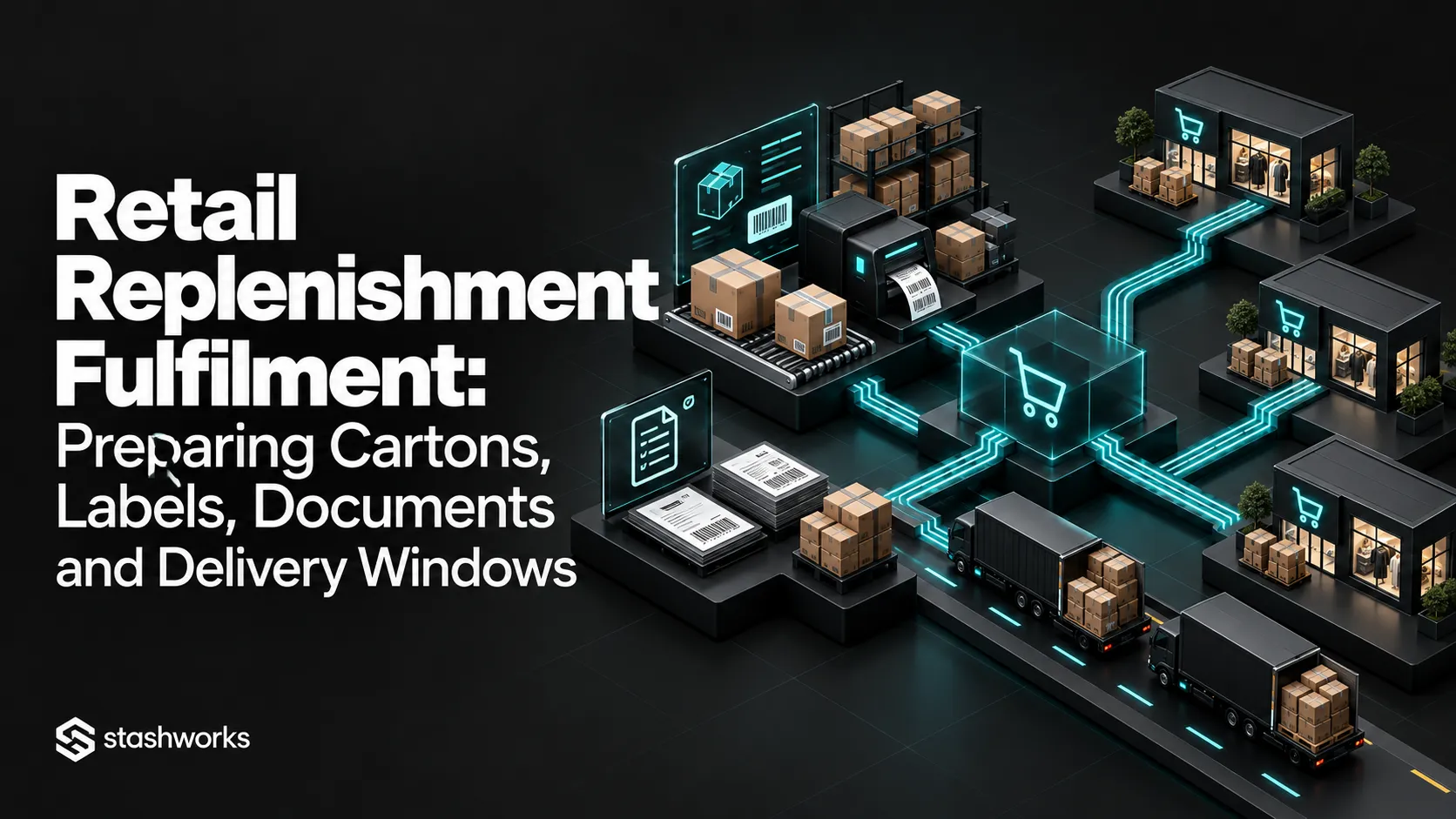
Retail replenishment fulfilment is different from shipping individual ecommerce parcels. The receiving retailer or distribution centre may expect cartons, pallets, logistic labels, purchase-order references, advance shipment information and a booked delivery window that matches its own receiving process.
The warehouse therefore needs to prepare the shipment to the retailer's vendor requirements, not simply pack products securely.
Start with the retailer's current vendor manual
Every retailer can define its own carton, label, ASN, pallet and booking requirements. Request the current specification for the exact distribution centre or store network.
Do not assume rules from another retailer or last year's version still apply.
Match every shipment to the purchase order
Confirm PO number, ship-to location, SKU or item reference, quantity, delivery date and any split-shipment rules before picking begins.
Retail receiving teams depend on the PO to know what the shipment is meant to contain.
Map retailer item codes to warehouse SKUs
The retailer can use its own item number while the warehouse uses the brand's internal SKU. Keep a controlled mapping between them.
Do not relabel the internal product identity simply to match a retailer code unless the agreed process requires it.
Define carton composition
A carton can contain one SKU, several SKUs or a store-specific assortment depending on the retailer requirement. The carton content should match the packing list and electronic shipment data.
Mixed cartons often need clearer content labelling because receiving cannot infer the contents from one item code.
Use logistic-unit identifiers where required
GS1's Logistic Label guideline uses the Serial Shipping Container Code to uniquely identify a logistic unit such as a case, pallet or parcel.
Scanning the SSCC allows the physical unit to be linked to electronic messages about the shipment.
Distinguish carton GTIN from logistic-unit SSCC
A trade-item carton can carry a GTIN, while a logistic unit carries an SSCC. They serve different identification purposes.
Do not use a product barcode where the retailer expects a unique shipment-unit identifier.
Print labels from approved data
Label content can include SSCC, PO, destination, store, carrier or product information depending on the retailer standard. Generate labels from controlled shipment data rather than manual typing where possible.
Place labels consistently
Retailer manuals can specify label orientation and position. Poor placement can make automated receiving difficult even when the barcode itself is valid.
Test the completed carton or pallet, not only the label file.
Keep carton counts aligned across systems
The warehouse record, packing list, ASN and carrier documents should agree on the number of cartons or pallets. Disagreement creates receiving exceptions.
Create the advance shipment notice where required
An ASN tells the receiver what is coming before it arrives. It can include purchase order, shipment, carton or pallet identifiers and expected quantities.
The warehouse or brand should know which system creates and transmits it and what happens if the ASN fails.
Book the delivery window
Distribution centres can require appointments or delivery windows. Confirm who books the slot, what references the carrier needs and what happens if transport is delayed.
A shipment prepared correctly can still be refused or rescheduled if it arrives outside the receiving process.
Plan pallet configuration
If the retailer requires pallets, define pallet type, maximum height or weight, wrapping, stacking and whether mixed-SKU pallets are accepted.
Use the retailer's current specification rather than a generic warehouse standard.
Protect carton integrity through transport
Retail replenishment cartons may be stacked and handled several times. Choose packaging that protects products and preserves scannable labels through the journey.
Handle shortages before dispatch
If the PO cannot be filled completely, follow the retailer's rule for partial shipment, backorder or cancellation. Do not silently ship less than the document states.
Handle substitutions only with approval
Retailers typically order specific item references. Do not substitute another variant or pack size because it appears commercially equivalent unless the retailer has approved that process.
Capture proof of dispatch and delivery
Keep shipment reference, carton or pallet IDs, carrier documentation, delivery appointment and proof of delivery where available.
This evidence helps investigate shortages, receiving disputes or deductions.
Track retailer-specific exceptions
Common issues include wrong label, missing ASN, PO mismatch, incorrect carton count, missed delivery window, damaged pallet and receiving shortage.
Use the queue discipline in Warehouse Exception Management so each issue has an owner and ageing status.
Measure deductions and rejection causes
Track retailer penalties, refused deliveries, shortages, relabelling, missed appointments and repeat documentation failures by root cause.
A recurring deduction is usually cheaper to prevent than to dispute repeatedly.
Connect retail replenishment to inventory allocation
Accepted retail commitments should reserve the required stock before ecommerce consumes it. Use Omnichannel Inventory Allocation to define channel priority and release rules.
Where Stashworks fits
Stashworks' Ecommerce Fulfilment and Warehousing services can support inventory preparation, cartonisation and outbound handling within the agreed scope. Retailer-specific labels, ASNs, booking windows and pallet rules should be scoped against the receiving partner's current requirements.
Sources: GS1, Logistic Label Guideline; GS1, Serial Shipping Container Code; Stashworks, Ecommerce Fulfilment.