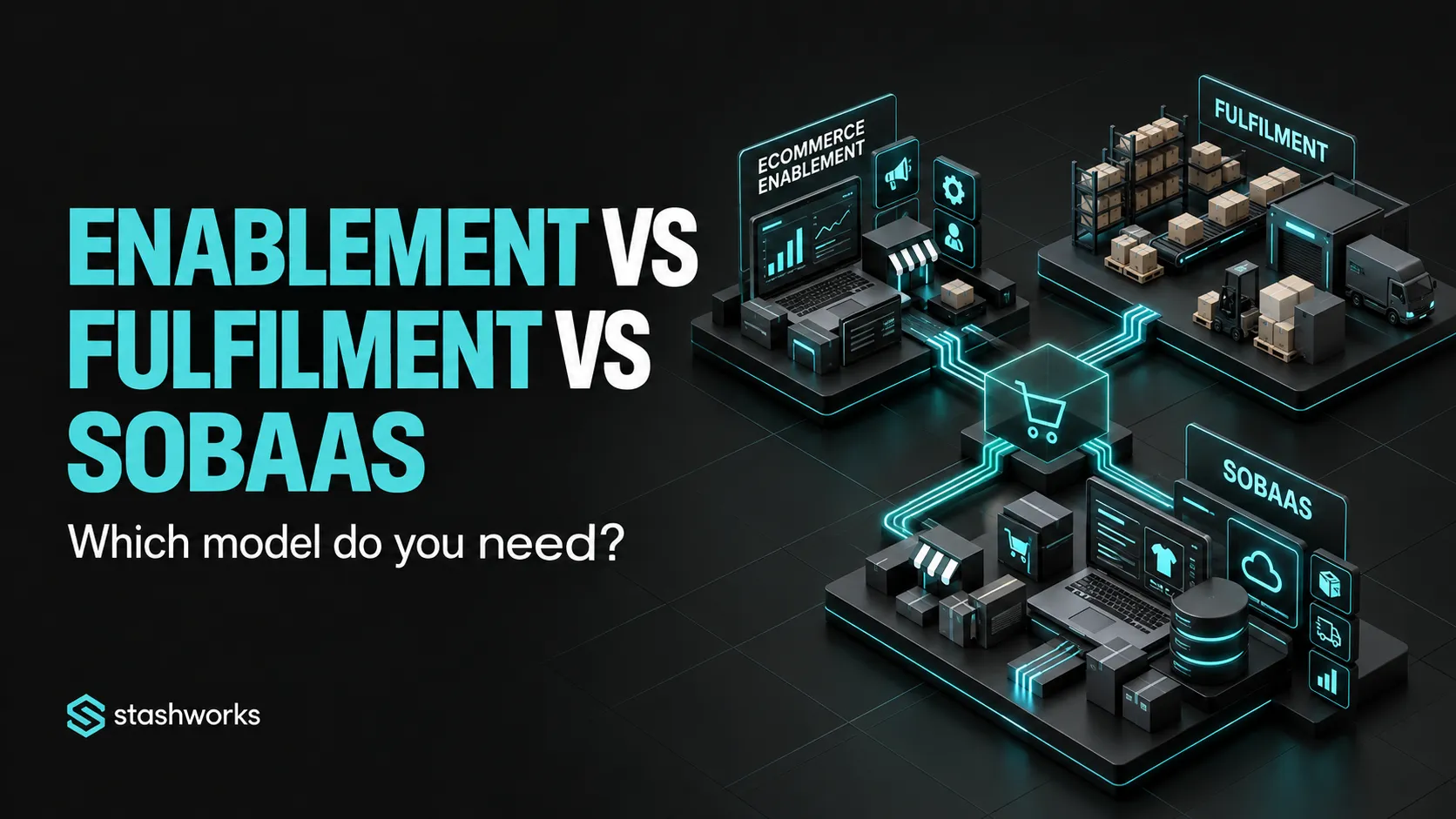
Ecommerce Enablement, Ecommerce Fulfilment and SOBAAS can all sit inside the same ecommerce operation, but they are not interchangeable. The simplest way to choose between them is to identify which problem needs solving: running sales channels, executing physical orders, or entering a supported market through a broader operating model.
A brand may need only one. It may also need two or all three, provided the responsibilities are defined clearly.
Ecommerce Enablement manages the channel-operation layer
Stashworks' Ecommerce Enablement service focuses on the work surrounding stores and marketplaces. The current service page includes platform management, product listings, campaign support, customer enquiries and coordination with fulfilment.
This is the right category to examine when the problem is marketplace administration rather than warehouse execution: too many listing updates, campaign coordination becoming manual, customer enquiries lacking ownership, or several channels being managed through disconnected workflows.
Ecommerce Fulfilment manages the physical order workflow
Ecommerce Fulfilment begins with inventory and orders. Stashworks' live service covers storage, picking, packing, dispatch and returns, with agreed value-added activities defined around the operation.
This is the service to evaluate when the bottleneck is physical capacity or order execution rather than marketplace administration. Typical triggers include running out of storage space, increasing dispatch workload, inconsistent packing, or an internal team spending too much time on warehouse tasks.
SOBAAS is a broader market-entry model
SOBAAS stands for Sell On Behalf As A Service. Stashworks currently positions it as a market-entry solution for supported Southeast Asian markets, combining an agreed mix of marketplace operations, local inventory and fulfilment, delivery and post-purchase support.
That makes it broader than standard fulfilment and different from ordinary marketplace management. It is intended for the operating questions that arise when a brand wants to enter a new supported market without building every local operational component independently.
Compare the three by the problem they solve
The table below is a practical decision tool rather than a statement that every engagement must include the same activities.
Choose Enablement when your channels are the bottleneck
A brand may already have a warehouse or 3PL that performs adequately, while the commercial team struggles to maintain multiple marketplaces. In that case, replacing the warehouse would not solve the real problem.
Enablement is more relevant when the workload sits in catalogue maintenance, marketplace administration, campaign execution and customer-operation coordination. The operating model should still specify what remains in-house, especially brand strategy, product decisions and approval authority.
Choose Fulfilment when the physical operation is the bottleneck
If the channel team is functioning well but storage, picking, packing or dispatch is consuming internal capacity, fulfilment is the more direct solution. The decision should be based on physical inventory, order profile, packaging needs, integrations and delivery requirements.
The article When Should You Outsource Ecommerce Fulfilment to a 3PL? provides a fuller framework for that transition.
Choose SOBAAS when the challenge is entering a supported market
A new-market project has a different risk profile. The brand must decide how selling activity, product readiness, marketplace operations, inventory, fulfilment, delivery and customer support will fit together in the target market.
Stashworks currently lists Singapore, Malaysia and Thailand as available SOBAAS markets. The exact commercial, marketplace, compliance and logistics arrangement is defined according to the market, product category and agreed scope.
SOBAAS should not be interpreted as removing the need for legal, tax, product or regulatory work. Those obligations depend on the actual market and selling arrangement and should be confirmed with qualified advisers where required.
Some brands need Enablement plus Fulfilment
This combination is logical when the brand wants one operating model connecting the storefront side and the warehouse side. Marketplace activity can then be coordinated with inventory, order processing and dispatch rather than managed as separate functions.
The existing guide on Multichannel Order Fulfilment explains why a shared operating view becomes more important as sales channels increase.
A market-entry setup can also include both layers
SOBAAS may incorporate ecommerce operations and fulfilment within the agreed market-entry scope. That does not mean the underlying functions stop being distinct. Clear ownership is still needed for listings, pricing, inventory, customer enquiries, warehouse execution, delivery and returns.
Keeping those responsibilities visible makes it easier to diagnose problems after launch.
Use a responsibility matrix before signing a scope
Write each operational task down and assign an owner, approver and escalation path. For example, a provider may maintain listings while the brand approves product claims and pricing; the provider may coordinate campaign setup while the brand approves discount strategy; the warehouse may manage physical stock while the brand controls purchasing.
This is more useful than buying a service name and assuming both parties interpret it the same way.
A practical decision sequence
Start with the constraint, not the service label. If the problem is digital channel workload, assess Ecommerce Enablement. If it is physical order execution, assess Fulfilment. If the business is trying to establish a route into a supported market, assess SOBAAS. If several constraints are connected, design a combined scope and define the boundaries.
Stashworks' live service pages intentionally separate these three models. That separation is useful because it allows brands to buy the operating support they actually need rather than treating every ecommerce problem as a warehouse problem.
If the decision is specifically about entering a new Southeast Asian market, continue with Sell On Behalf as a Service and SOBAAS vs a Local Entity vs a Distributor to compare the market-entry structures in more detail.
Sources: Stashworks, Ecommerce Enablement; Stashworks, Ecommerce Fulfilment; Stashworks, SOBAAS.