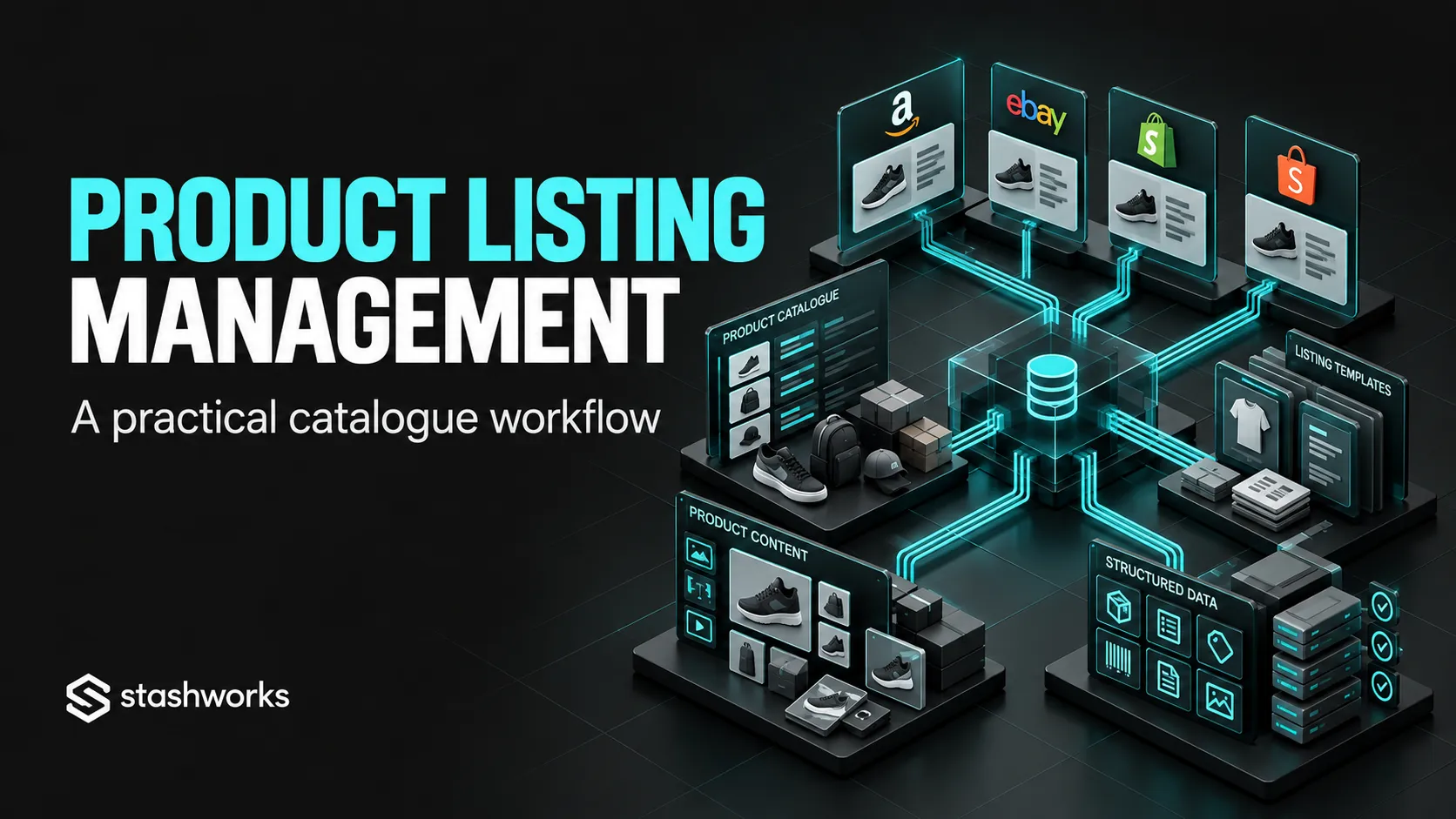
Product listing management becomes difficult when a brand treats each marketplace as an independent catalogue. The same product is copied into several seller centres, edited by different people and gradually turns into several versions of the truth.
A better model uses one governed product record, then translates that record into the format and merchandising requirements of each marketplace.
Separate the master product record from the marketplace listing
The master record should hold the facts that identify the product regardless of channel: internal SKU, variant structure, barcode where applicable, pack size, physical dimensions, weight, approved product name and core specifications.
The marketplace listing is a channel-specific representation of that product. Its title, category, images, attribute order, promotional copy and merchandising may differ without changing the underlying identity.
Build one variant structure before you publish anywhere
Variants are where catalogue errors often begin. Colour, size, scent, pack quantity or other options should be defined once, with each sellable variant mapped to a stable internal SKU.
Shopify's current product tools, for example, allow variants to carry their own SKU, barcode, weight and other details. Its product guidance also notes that SKUs should be unique for effective tracking and reporting, while barcodes can act as product identifiers across scanning and marketplace workflows.
The existing SKU Management guide explains how to keep these identifiers usable inside fulfilment.
Create a channel-mapping table
The mapping table links the internal product to every marketplace record. It should make it possible to answer, without opening several dashboards, which marketplace listing corresponds to which warehouse SKU.
Use a controlled content workflow
Product facts and marketing copy should not be edited with the same approval rules. A typo in a lifestyle sentence is different from an incorrect pack quantity, ingredient claim or compatibility statement.
Create a content approval path that distinguishes factual product data, regulated or sensitive claims, merchandising copy and marketplace-specific formatting. The brand should retain approval authority over any statement that carries legal, regulatory or reputational risk.
Validate the physical product against the listing
A digital catalogue can be internally consistent and still be wrong if it does not match the physical item in the warehouse. Before launch, compare the product record with what arrives: barcode, variant label, pack count, dimensions and weight.
This matters because listing errors can become fulfilment errors. A marketplace variant called “2-pack” mapped to a warehouse SKU containing one unit is not only a content problem; it creates a customer-order problem.
Assign one owner for new-product setup
New launches often fail because commercial, content and operations teams each complete only their own part. Use one launch owner to confirm product data, listing assets, price approval, channel mapping, stock readiness and fulfilment setup before the listing becomes orderable.
That owner does not need to perform every task, but should be able to see whether all dependencies are complete.
Handle channel-specific fields as controlled extensions
Marketplaces differ in category trees, mandatory attributes, title conventions, image rules and promotional fields. Keep those differences in channel-specific columns or records rather than overwriting the master data to suit one platform.
This makes it easier to change a channel-specific title or attribute without corrupting the product information used elsewhere.
Build an update workflow, not only a launch workflow
Catalogues change constantly. Products are reformulated, packaging changes, variants are discontinued, bundles are introduced and marketplace requirements evolve.
Every change should identify the affected product, the source of truth, the channels that need updating, whether warehouse data also changes, and who verifies completion. Otherwise a clean catalogue at launch can become inconsistent within months.
Treat delisting as a controlled process
Removing a listing requires more than switching it off. Confirm whether open orders remain, whether stock is still sellable on other channels, whether the SKU is being discontinued entirely, and whether advertising or campaign references still point to the product.
For multichannel inventory, the guide How to Manage Inventory Across Shopify, Shopee, Lazada and TikTok Shop explains why one product disappearing from a channel should not automatically change the physical inventory record.
Use exception queues instead of manual memory
Rejected listings, missing attributes, duplicate SKUs, unmapped variants and unavailable images should enter a visible exception queue with an owner and due date. If these issues live only in email threads or seller-centre notifications, the catalogue becomes harder to govern as it grows.
Connect listing operations to fulfilment before publishing
Stashworks' Ecommerce Enablement service includes listing creation, product and variant setup, catalogue maintenance and marketplace administration. Its Ecommerce Fulfilment and technology services provide the physical and systems connection after orders begin.
The practical takeaway is simple: a listing should not be treated as complete until its product identity, inventory mapping and fulfilment path are also clear.
For regional expansion, the catalogue also needs a country-specific layer. See Localising Marketplace Listings for Southeast Asia and the Product Compliance Research Checklist before adapting regulated product information.
Sources: Stashworks, Ecommerce Enablement; Shopify Help Center, Product details; Amazon Singapore Seller University; Lazada University Singapore.