A dashboard can refresh every few seconds and still show the wrong inventory.
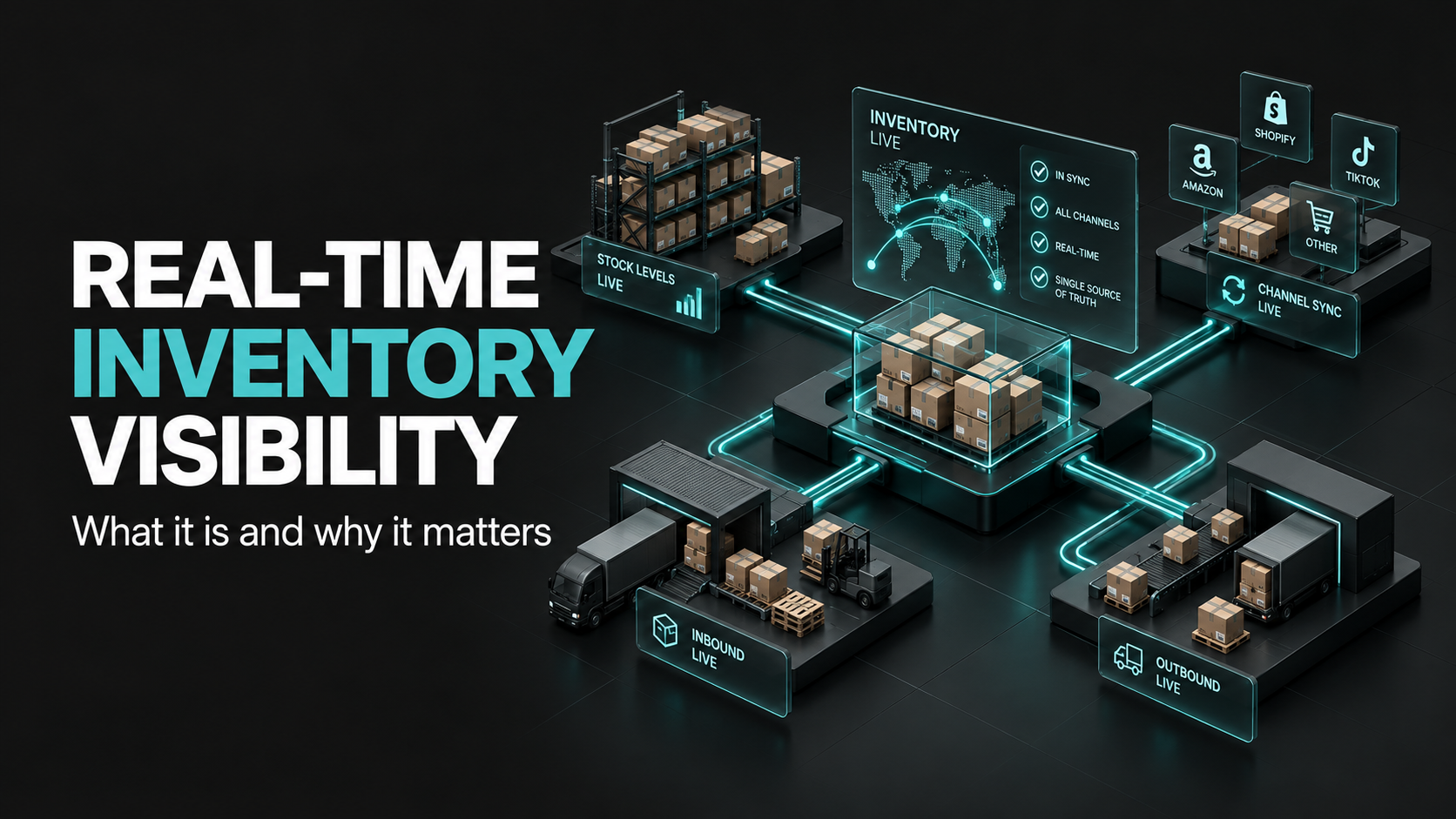
Real-time visibility is often described as a software feature, but the harder requirement sits underneath the screen: every important physical and commercial inventory event has to be captured, assigned to the correct product and location, and reflected in the quantity used for decisions.
That is why real-time inventory visibility is an event-and-state problem before it is a dashboard problem.
“Real time” means inventory changes are posted as the operation changes
Shopify describes real-time inventory as continuously updating stock levels as goods are received, moved and sold. Microsoft’s Inventory Visibility service similarly supports real-time on-hand change postings and inventory tracking across data sources and channels.
No business should assume the phrase guarantees literal zero latency in every connected system. The useful question is whether inventory-changing events are captured and propagated quickly enough for the decisions the business is making, and whether any delay or failure becomes visible.
On-hand stock is not the same as available stock
A warehouse can physically hold 100 units while fewer are available to sell. Some may already be reserved for orders, damaged, quarantined, returned but not inspected, or allocated to another channel.
A visibility system should therefore show meaningful inventory states, not one undifferentiated total. Otherwise a precise-looking number can still create overselling.
Location is part of the inventory answer
“We have 50 units” is incomplete when those units are split between a warehouse, retail location, returns area or several fulfilment sites.
Good visibility preserves the location dimension so the business can distinguish total ownership from stock that is actually positioned to fulfil a particular order. Shopify’s current inventory-tracking guidance emphasises both quantity and location as core parts of inventory visibility.
Receiving should change visibility only when the receiving event is understood
A supplier delivery reaching the dock does not automatically mean every expected unit is saleable. Quantity still has to be verified, damage recorded and stock assigned to the correct status and location.
If the system adds purchase-order quantity before actual receiving is complete, the ecommerce channel can promise stock that the warehouse has not verified. Visibility should reflect what physically happened, not what the supplier was expected to send.
Reservations prevent multiple channels from promising the same unit
When an order is accepted, the inventory system may need to reserve or allocate stock before it is physically picked. That reduces what other customers can buy even though the unit remains on the shelf.
Microsoft’s Inventory Visibility documentation distinguishes on-hand quantities, reservations and allocations for this reason. A multichannel business needs the same discipline: one physical unit should not be treated as available to several channels after it has been committed.
Cancellations are inventory events too
If an order is cancelled before fulfilment, its reservation may need to be released. If it is cancelled after picking or dispatch, the operational path is different.
The inventory system should reflect that status change in a controlled way. Simply adding the unit back because the storefront says “cancelled” can be wrong if the parcel has already left the warehouse.
Returns should not become available at first scan
A returned product may need inspection, repacking, quarantine or write-off. Real-time visibility does not mean changing the available balance as early as possible. It means changing the correct inventory state when the real event occurs.
This is why reverse logistics and inventory visibility are inseparable. The physical unit and the customer-facing transaction move through different stages before the stock can be sold again.
Manual adjustments need as much visibility as automated movements
Cycle counts, damage discoveries, found stock and approved write-offs can all change inventory outside the normal order flow.
Those adjustments should carry a reason, user and timestamp. Otherwise the dashboard may be current but the business cannot explain why the number changed.
Channel synchronisation needs a source of truth
A brand selling through Shopify, Shopee, Lazada, TikTok Shop or other channels may have several systems capable of displaying or changing stock. Define which operational record owns the available quantity and how channels receive updates.
The broader architecture is covered in Multichannel Order Fulfilment. Real-time visibility is the quality of the inventory information moving through that architecture.
Integration failures should create exceptions, not silent drift
Every integration can fail temporarily. What matters is what happens next.
Ask whether failed inventory updates are retried, queued or surfaced for reconciliation. If one marketplace stops receiving stock changes for two hours, the business needs to know which SKUs and events are affected rather than discovering the problem through oversold orders.
Reconciliation proves that systems still agree
Real-time event flow reduces delay, but it does not eliminate the need for reconciliation. Compare warehouse inventory with connected channel or platform records and investigate differences.
This is especially important after outages, bulk imports, catalogue changes or migrations. A system can process new events perfectly while carrying an old discrepancy forward indefinitely.
Visibility becomes useful when it changes a decision
The operational value is not simply seeing a number faster. Reliable visibility supports decisions such as whether an item can be sold, when to reorder, whether stock should move between locations, which orders can be released and which inventory needs investigation.
That is why accuracy and visibility must be considered together. Fast wrong data is more dangerous than slower data whose limitations are understood.
Test the difficult inventory events in a provider demo
When evaluating a 3PL or WMS, do not ask only to see the inventory dashboard. Ask what the quantity shows after a partial receipt, a new order, a cancellation, a failed pick, a damage adjustment and a returned item awaiting inspection.
Then ask how those changes reach connected ecommerce channels and how failed synchronisation is surfaced.
Stashworks positions its technology layer around inventory and order visibility. The useful proof is the event flow behind that visibility: how warehouse movements, statuses and channel updates stay aligned.
Real-time visibility is trustworthy when the number has context
A strong inventory view can answer more than “How many?” It can explain where units are, what state they are in, what is reserved, what is incoming, what changed and which exceptions still need attention.
That context is what turns inventory data into an operational control system rather than a live-looking counter.
Sources: Shopify, Real-Time Inventory; Shopify, Inventory Tracking; Microsoft Learn, Inventory Visibility Overview.